January 28, 2026
Mastering the Shallows: The Strategic Advantage of Jack-Up Rigs in Offshore Operations
In the complex ecosystem of offshore energy, the deep-water giants often dominate the headlines. However, some of the industry’s most critical engineering challenges occur in the “shallows”—zones where high tidal ranges, shifting seabeds, and harsh weather create a logistical nightmare for standard vessels. In these environments, the Jack-Up Rig (and its agile cousin, the Liftboat) reigns supreme.
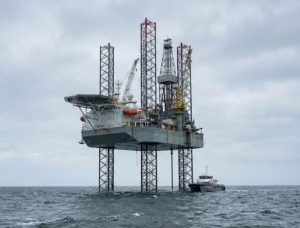
For operators in regions like Liverpool Bay, the choice of vessel is not just about capacity; it is about stability and precision. A prime example of this engineering philosophy is the Irish Sea Pioneer, a vessel that demonstrates exactly why self-elevating units are indispensable for shallow-water field maintenance.

1. Stability in a Dynamic Environment
The primary benefit of a jack-up vessel is its ability to eliminate vessel motion entirely. In shallow seas, wave action is often steeper and more frequent, making operations from a floating vessel (like a barge or ship) dangerous or impossible due to heave.
By lowering its legs to the seabed and elevating its hull above the wave crests, a jack-up transforms itself from a ship into a temporary fixed platform. This “air gap” (on the Irish Sea Pioneer, for instance, this can be nearly 4 meters above storm waves) provides a stable deck for delicate crane operations, wireline services, and coiled tubing interventions that would be halted by weather on a floating hull.
2. The “SEWOP” Advantage: Logistics Without Tugs
While traditional drilling jack-ups are massive, barge-like structures that must be towed into position, the modern solution for field maintenance is the SEWOP (Self-Elevating Work Over Platform).
The Irish Sea Pioneer exemplifies the “self-propelled” advantage. Equipped with azimuthing thrusters, it can navigate between platforms at 8 knots without the assistance of tugboats. In a field like the Douglas Complex, where satellite platforms are unmanned and lack heavy cranes or accommodation, the SEWOP acts as a mobile logistics hub. It drives itself to the location, jacks up, and instantly provides the hotel services, crane power, and workshops that the satellite platform lacks. This eliminates the massive daily expense and weather-dependency of organizing tug fleets for every move.
3. Engineering for the Seabed
Shallow waters often come with tricky seabeds—soft clays or shifting sands that can trap a rig’s legs. Advanced jack-ups mitigate this with specialized spud cans (the footings at the bottom of the legs).
For example, the Irish Sea Pioneer utilizes a high-pressure jetting system built into its spud cans. By blasting water through nozzles in the feet, the vessel can fluidize the sediment to ensure proper penetration when setting up, or break the suction effect when extracting legs to move off location. This capability is critical in areas like the Irish Sea, allowing the vessel to “walk” between locations efficiently without getting stuck in the mud.
4. Cost-Effective Field Life Extension
Perhaps the most significant benefit is economic. Using a lighter, self-propelled jack-up for well intervention is vastly cheaper than mobilizing a full-sized drilling rig.
-
Lower Day Rates: Specialized liftboats cost significantly less to operate than drilling rigs.
-
Efficiency: Electric jacking systems, like the rack-and-pinion drive on the Pioneer, offer ~92% efficiency and reduce the maintenance and spill risks associated with older hydraulic systems.
-
Versatility: These vessels can perform heavy lifts (up to 36 tonnes in the Pioneer’s case) and support well interventions simultaneously, reducing the need for multiple specialized vessels.
Conclusion
The jack-up rig is not merely a platform; it is a strategic tool that extends the life of aging fields. By bringing stability to turbulent waters and mobility to heavy industry, vessels like the Irish Sea Pioneer prove that in shallow water, the best way to work is to stop floating and start standing.

About the Author
Loïc Coyot
As business operations director Loïc runs global operations excellence across multiple departments, including sales ops, customer success, customer support and growth.